 ultimate-guide
How to Choose Commercial Roofing Contractors: 2026 Guide
Table of Contents
- Start with Licensing, Insurance, and Financial Stability
- Questions to Ask Commercial Roofing Contractors Before You Sign
- Evaluate Experience with Flat Roofing Systems and Material Specifications
- How to Verify Local References and Online Reputation
- Review the Written Estimate, Contract Terms, and Project Scope
- Commercial Roof Maintenance Checklist for Post-Installation Care
- Red Flags and Subcontractor Vetting
- Conclusion
- Frequently Asked Questions
Last Updated: October 7, 2026
Start with Licensing, Insurance, and Financial Stability
Choosing commercial roofing contractors starts with three non-negotiables: a verified state license, active insurance, and enough financial stability to finish the job. Skip any one of them and you own the risk, not the contractor.
At American Environmental Services, we have spent over 20 years diagnosing and correcting complex roofing problems on commercial buildings, and we have watched owners learn this lesson the hard way.
State License Verification and Bonding Capacity
State license verification is the process of confirming a contractor holds a current, valid license to perform commercial roofing work in your state through the official licensing board.
Bonding capacity matters just as much. A surety bond protects you if the contractor fails to complete the work or violates contract terms. A contractor who cannot secure a bond at the level your project requires is a contractor who may not finish.
General Liability and Workers' Compensation Coverage
General liability insurance covers property damage and third-party injuries caused by the work. Workers' compensation covers crew members injured on your property. If a roofer falls and the contractor carries no workers' compensation policy, your building's insurance can absorb the claim.
Request certificates directly from the contractor's insurer, not from the contractor. Confirm the policy is active on the date work begins, and check that coverage limits match the scale of your building.
Questions to Ask Commercial Roofing Contractors Before You Sign
The right questions separate a professional operation from a crew with a truck and a ladder. Ask these before any contract is signed, and ask them in person.
- Who is the licensed qualifier on this project, and will they be on site?
- Which manufacturer certifications does your company hold?
- How do you handle emergency repair services outside normal business hours?
A contractor who hesitates on licensing, insurance, or subcontractor vetting is telling you something. Listen.
Evaluate Experience with Flat Roofing Systems and Material Specifications
Commercial flat roofing is a different discipline from residential shingle work, and experience does not transfer automatically. A crew that has spent a decade on steep-slope homes may never have installed a fully adhered single-ply membrane or a modified bitumen system.
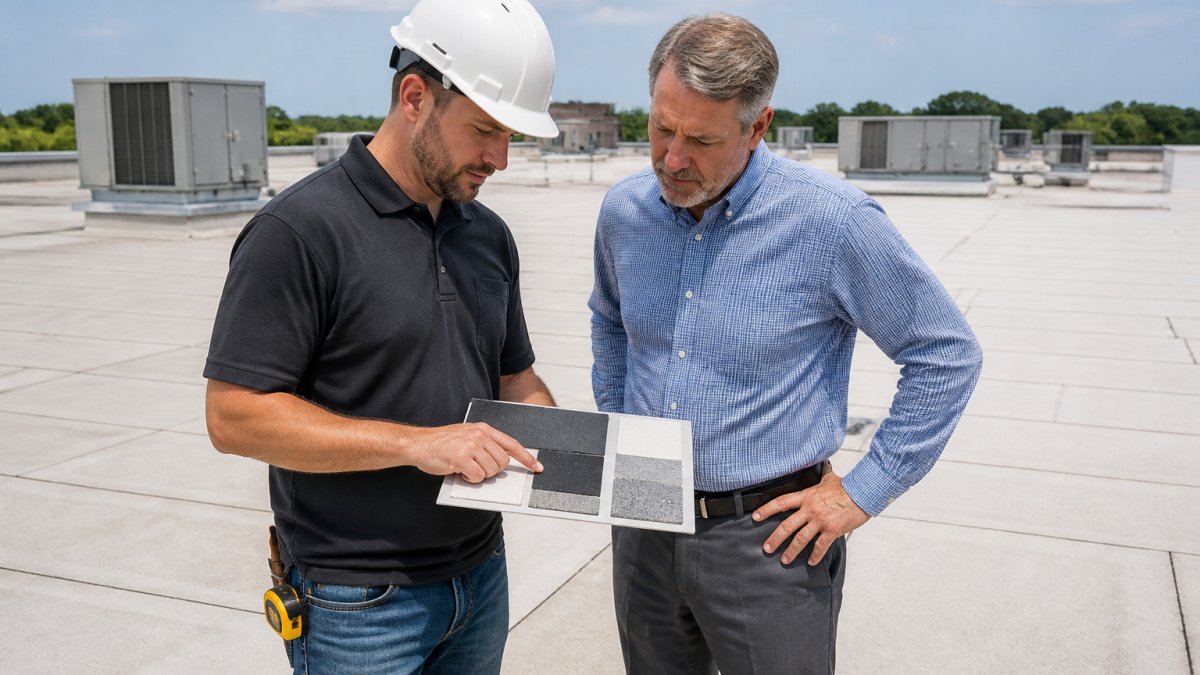
Ask what percentage of their work is commercial. Ask which roofing system installation methods they use most: TPO, EPDM, PVC, modified bitumen, or built-up roof. Then ask why they would recommend one over another for your building.
Manufacturer Certification and Roofing System Installation
Manufacturer certification means the contractor has been trained and authorized by a roofing materials manufacturer to install that company's systems. This matters for one practical reason: most manufacturer warranties require certified installation. An uncertified installer voids the warranty before the first rain.
Material specifications should be written into the contract, not left verbal. Membrane thickness, insulation R-value, fastener type, and flashing details all belong on paper.
How to Verify Local References and Online Reputation
Local references are the single most reliable predictor of future performance. Ask for three to five references from commercial buildings similar to yours, ideally within driving distance, and then actually call them.
Ask each reference specific questions:
- Did the project finish on the agreed timeline?
- Did the final invoice match the written estimate?
- Did any leaks return after the work was completed?
Online reputation fills in the gaps. Check Google reviews, the Better Business Bureau, and any state licensing board complaint records. A pattern of unresolved complaints about leaks or billing disputes is a red flag that a polished website will not hide.
Review the Written Estimate, Contract Terms, and Project Scope
A written estimate should describe the work in enough detail that two contractors bidding the same job would produce comparable documents. If one bid is a single page and another runs eight pages, you are not comparing the same scope, you are comparing a sketch against a set of construction documents.
The practical test: hand Bid A to Bid B's estimator and ask whether they could build from it. If the answer is no, the cheaper number is not a real number.
Project scope must spell out:
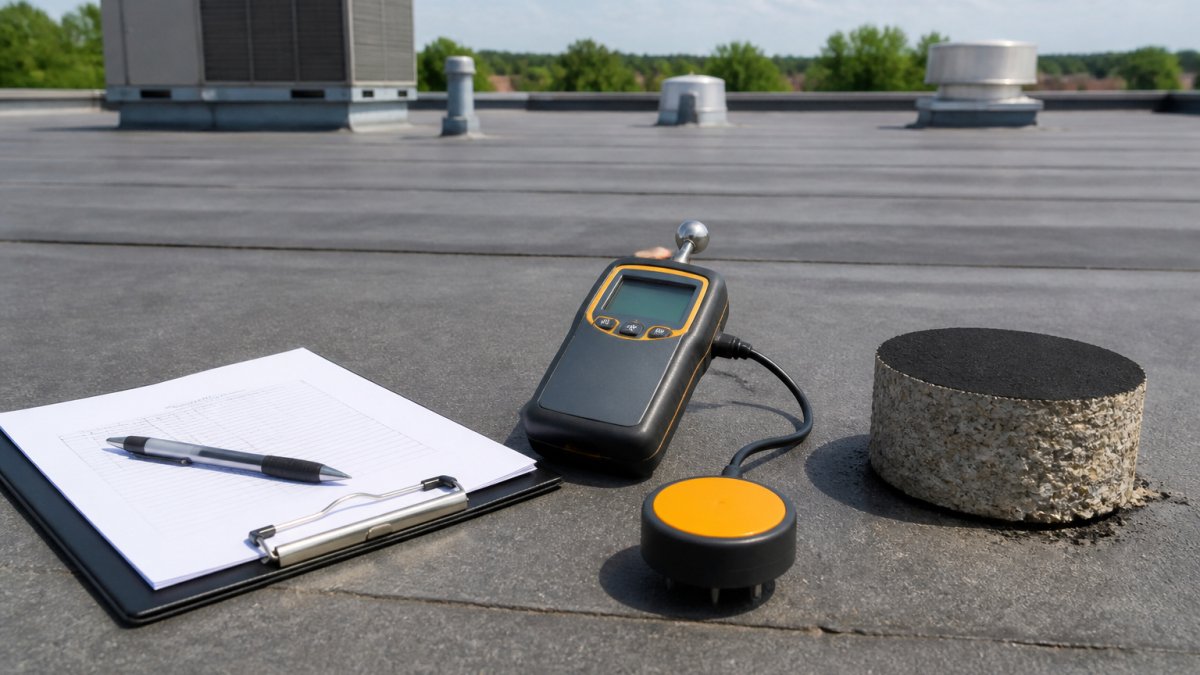
- Total roof area, deck type, and substrate condition (including how the contractor assessed it, core cuts, moisture survey, infrared scan, or visual only)
- Removal and disposal of existing materials, including whether tear-off is full or partial and where debris will be staged
- Membrane manufacturer, product line, thickness (mil), and attachment method (mechanically attached, fully adhered, induction-welded, or ballasted)
Contract terms should address change orders, dispute resolution, lien waivers, and what happens if the contractor discovers hidden damage mid-project. Vague contracts favor the contractor. Specifically, insist on:
- A written change-order process with unit pricing agreed in advance (so a mid-project surprise is priced before it happens, not after)
- Conditional lien waivers from the contractor and every subcontractor and supplier at each payment
- A dispute resolution clause that names mediation before litigation
Payment Schedule and Project Timeline
A reasonable payment schedule ties payments to milestones, not calendar dates. A common commercial structure is a mobilization deposit, progress payments tied to verified completion percentages, and retainage withheld until punch-list items are closed and lien waivers are collected.
The project timeline should include start date, weather contingency, a completion target, and a defined cure period for punch-list items. Commercial roofing is weather-dependent, so a contractor who promises an exact finish date without mentioning rain delays is either new or not being straight with you.
Financial Stability Checks Before You Sign
Commercial projects are expensive enough that a contractor's balance sheet is part of your risk. A firm that is undercapitalized can stall mid-project, walk away, or leave suppliers unpaid, which can trigger a mechanics lien against your building even after you have paid the contractor in full.
Ask for:
- A current certificate of insurance showing general liability and workers' compensation limits, with your building named as an additional insured for the project
- A letter of credit or financial reference from the contractor's bank or bonding agent
- Proof of an active surety bond at the level your project requires
You do not need to audit their books. You need to confirm they can buy materials, pay crews, and finish the job without depending on your next progress payment to do it.
Commercial Roof Maintenance Checklist for Post-Installation Care
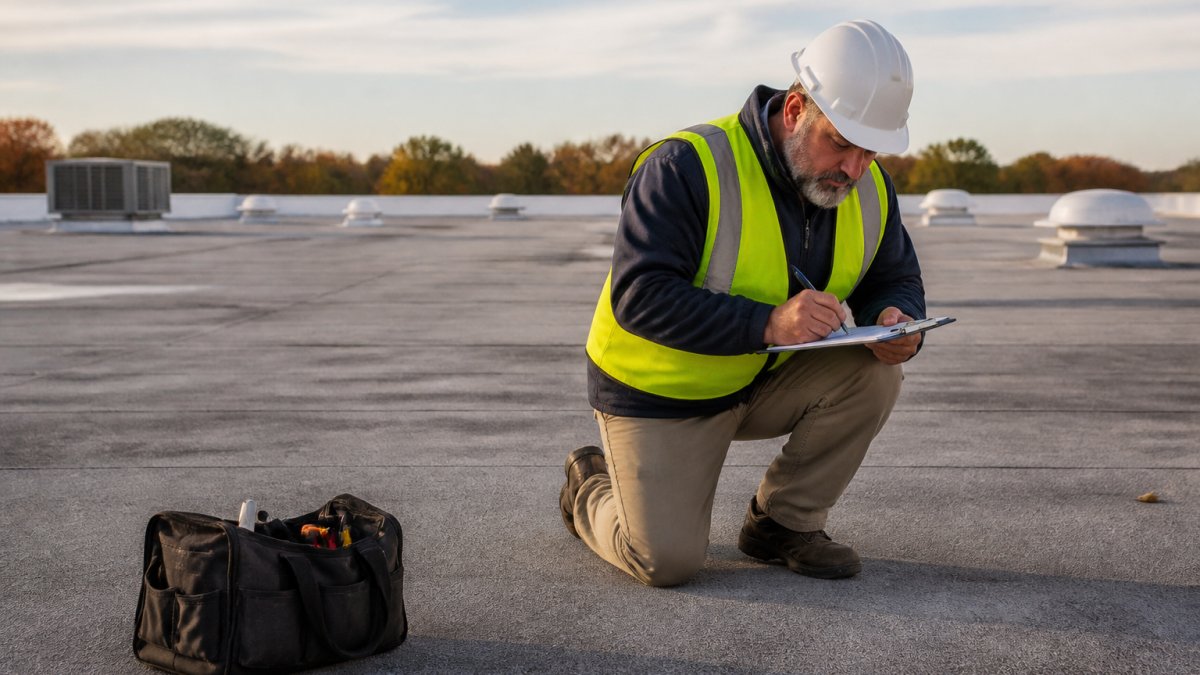
A commercial roof maintenance checklist turns a new roof into a long-lived asset. Most premature roof failures trace back to neglected drainage and undetected seam damage, not to defective materials.
Use this checklist for routine inspections:
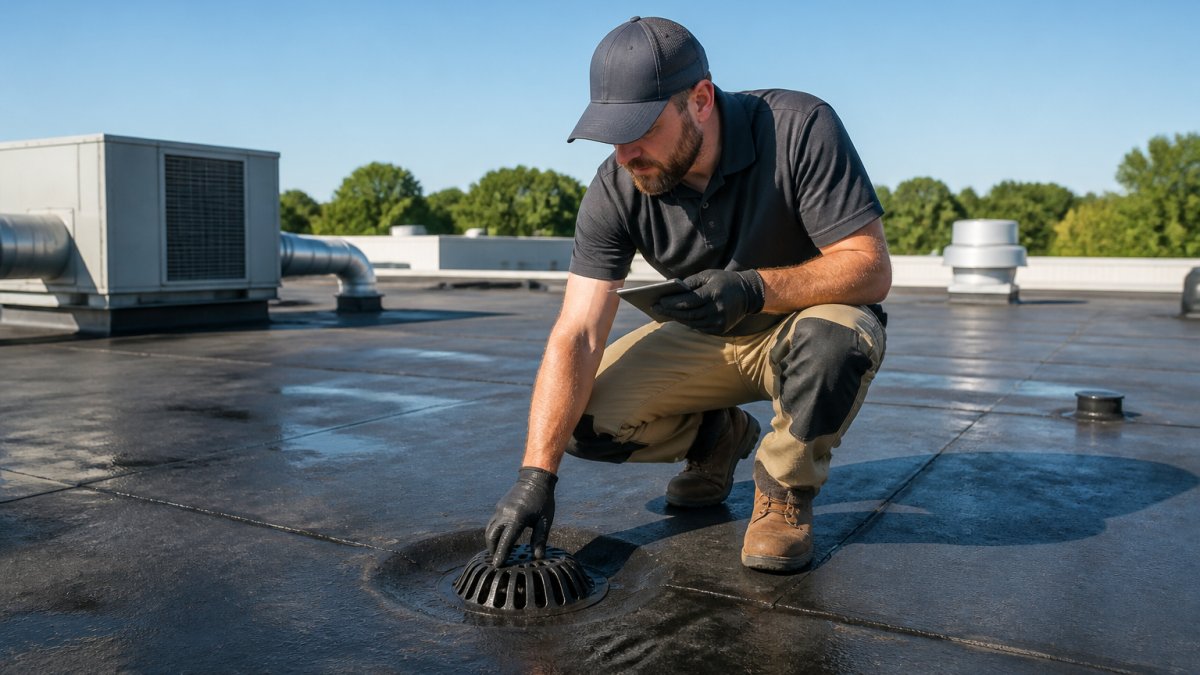
- Clear drains, scuppers, and gutters of debris
- Inspect membrane seams and flashing for separation
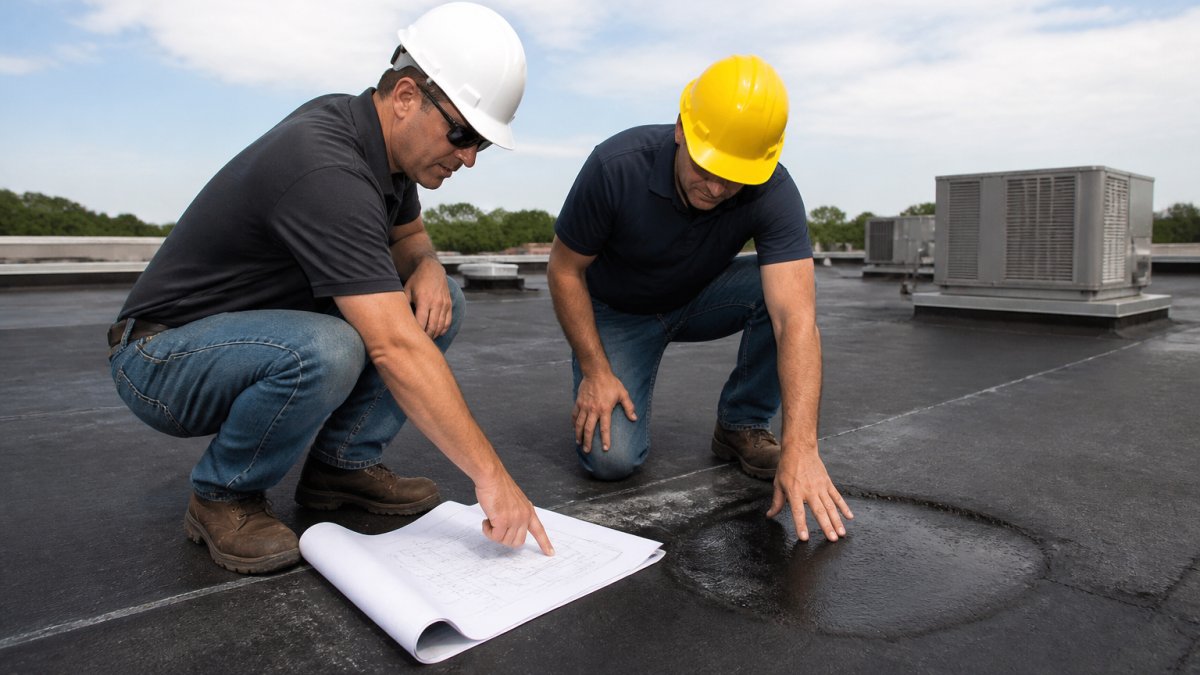
- Check for ponding water 48 hours after rainfall
Preventative maintenance is not a sales tactic. It is the difference between a roof that reaches 20 years and one that fails at 12.
Red Flags and Subcontractor Vetting
Subcontractor vetting is where most owners lose control of a project. A general contractor may hold every license and insurance policy you asked for, then hand the actual installation to a crew you never vetted.
Start by asking one direct question: does your company self-perform the roofing work, or will it be subcontracted? Both answers can be acceptable. What matters is that you know which one you are buying, and that you vet the people who will actually be on your roof.
Self-Perform vs. Subcontract, Why It Matters
A contractor who self-performs installation controls scheduling, quality, and safety training directly. A contractor who subs out the work is managing a third party whose incentives, insurance, and training may not match what you were promised.
Neither model is automatically better. A specialty contractor who self-performs single-ply work but subs out sheet metal fabrication may deliver a better roof than a generalist who claims to self-perform everything.
Ask for:
- A written list of every subcontractor expected on the project, by trade (membrane, insulation, metal, flashing, HVAC coordination)
- Each sub's state license number, general liability certificate, and workers' compensation certificate
- Each sub's OSHA training documentation, 10-hour or 30-hour cards for foremen, and proof of fall-protection training for anyone working at height
If the contractor resists this request, they are not protecting trade secrets. They are hiding something.
Insurance and Liability Flow-Through
Your protection depends on coverage flowing all the way down. A prime contractor's general liability policy does not automatically cover a subcontractor's negligence. If a sub's crew damages an HVAC unit or drops a fastener through a membrane, the claim path runs through the sub's policy first.
Confirm that:
- Each subcontractor carries its own general liability and workers' compensation coverage at limits that meet or exceed the prime's
- The prime's policy includes a subcontracted work endorsement or equivalent
- Your building is named as an additional insured on both the prime and sub policies for the duration of the project
Red Flags to Walk Away From
- Pressure to sign today for a "locked-in" price
- No permanent business address, only a PO box or cell number
- Cash-only payment requests
A contractor who hesitates on licensing, insurance, subcontractor vetting, or safety documentation is telling you something. Listen.
Conclusion
Vetting a commercial roofing contractor is slower than accepting the lowest bid, and that is exactly the point. The owners who skip licensing checks, insurance verification, and reference calls are the same ones filing claims two years later.
American Environmental Services has spent more than two decades diagnosing and correcting complex roofing problems across commercial buildings.
Request a quote and let our team show you what a properly vetted commercial roofing partner looks like.
Frequently Asked Questions
What credentials should a commercial roofing contractor possess?
A qualified commercial roofing contractor should hold a current state license, carry general liability insurance and workers' compensation coverage, and maintain manufacturer certifications for the roofing systems they install. Ask for their bonding capacity and verify their permanent business address. You should also confirm they follow OSHA regulations and can pull the necessary permits for your project. These credentials protect you from liability and ensure the work meets building codes.
How do I verify the insurance and licensing of a roofing company?
Request a certificate of insurance directly from the contractor and call the insurance provider to confirm the policy is active and covers commercial roofing work. For licensing, contact your state licensing board or check their online database. Verify the license number matches the company name on the contract. Also ask whether they carry workers' compensation, because if a worker is injured on your property without coverage, you could face liability.
What are the red flags to watch for when hiring a commercial roofer?
Watch for contractors who demand large upfront payments, refuse to provide a written estimate, or cannot supply local references from similar commercial buildings. Be cautious if they lack a permanent business address, pressure you to sign immediately, or subcontract all work without disclosing it. A contractor who will not show proof of insurance or licensing should be eliminated from consideration. These warning signs often indicate financial instability or poor workmanship.
How does proactive maintenance impact the selection of a roofing contractor?
Choosing a contractor who offers preventative maintenance programs can extend your roof's lifespan and reduce emergency repair costs. Ask whether they provide scheduled roof inspections, leak detection, and a written commercial roof maintenance checklist. A contractor focused on long-term asset management will help you avoid premature replacement. This approach also keeps warranty terms valid, since most manufacturers require documented maintenance to honor workmanship warranties.
Why is specialized experience in flat roofing critical for industrial buildings?
Flat and low-slope roofing systems common on industrial buildings require specific installation techniques and materials that differ from residential steep-slope work. A contractor without flat roofing experience may miss drainage issues, improper membrane seams, or insulation problems that lead to leaks. Ask for project history on similar buildings and confirm they hold manufacturer certifications for the membrane systems they install. Specialized experience directly affects how long your roof performs.
What should I include in a commercial roof maintenance checklist?
A thorough commercial roof maintenance checklist should cover routine roof inspections, debris removal from drains and gutters, checking membrane seams and flashing, inspecting HVAC unit curbs, and documenting any ponding water. Schedule inspections at least twice a year and after major storms. Keep written records of all maintenance because manufacturer warranties often require documented care. This checklist helps you catch small issues before they become costly structural problems.